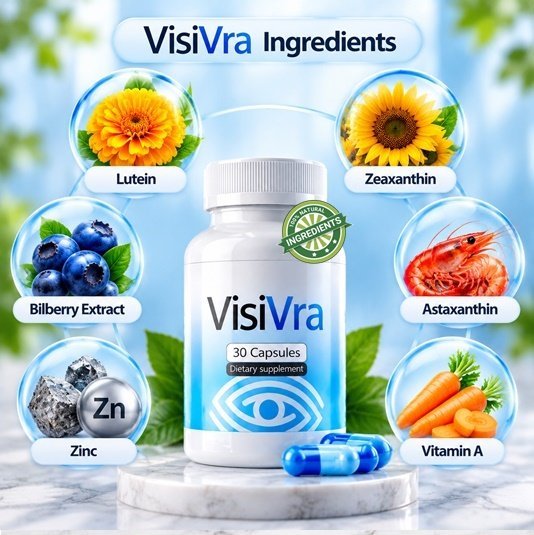
The 6-bottle bundle works out at $49 a bottle; every bundle carries a 60-day refund window that starts on your purchase date.
See Visivra OfferPaid linkQuick profile
| Profile | |
|---|---|
| Family | Xanthophyll carotenoid (red) |
| Main source | Microalga Haematococcus pluvialis |
| Claimed role | Antioxidant; eye fatigue during screen work |
| Research dose | 9 mg/day for 6 weeks (2023 RCT) |
| Safety reference | EFSA: ≤ 8 mg/day from supplements, adults |
| Visivra dose | Not published |
| Grade | C — limited |
From algae to salmon to capsules
Astaxanthin is made by microalgae to shield themselves from harsh sunlight. Krill and shrimp eat the algae, salmon eat the krill — which is why wild salmon flesh is pink. Supplements typically extract it from cultivated Haematococcus pluvialis algae.
How it might help tired eyes
Two ideas dominate:
- Antioxidant protection — astaxanthin is a potent antioxidant in lab tests and can sit across cell membranes.
- Focusing-muscle relief — researchers suggest it may ease fatigue in the ciliary muscle, which works hard during prolonged close-up focus.
Both are plausible, neither is firmly proven in people.
The seller offers 2-, 3- and 6-bottle bundles. If you take prescription medicine, show the label to your pharmacist first.
See Visivra OfferPaid linkThe 2023 trial in screen workers
| Detail | Finding |
|---|---|
| Study | Sekikawa et al., J Clin Biochem Nutr 2023 (J-STAGE) |
| Design | Randomised, double-blind, placebo-controlled |
| People | 60 healthy adults, 20–64, doing regular screen work |
| Dose and length | 9 mg/day for 6 weeks |
| Positive result | Age 40+: better dominant-eye visual acuity after screen work vs placebo |
| No difference | Under 40; functional visual acuity; pupil constriction |
| Funding | The astaxanthin supplier (NutraIngredients) |
A small, industry-funded study with a result in one subgroup. Interesting, not conclusive.
In combination formulas for AMD
The Linus Pauling Institute describes a trial in 74 people with intermediate AMD using a mixture that included 4 mg astaxanthin plus lutein, zeaxanthin, vitamins C and E, zinc, copper and fish oil. Progression was lower than placebo — but with so many ingredients, astaxanthin’s own role can’t be separated.
Dose and safety
| Reference | Astaxanthin |
|---|---|
| 2023 screen-work trial | 9 mg/day |
| EFSA safe level from supplements (adults) | Up to 8 mg/day |
| Visivra per serving | Not disclosed; part of the 351 mg proprietary blend |
The European Food Safety Authority (EFSA) concluded that up to 8 mg/day from food supplements, on top of normal dietary intake, is safe for adults. Data for pregnancy, breastfeeding and children are limited.
Interactions
No major drug interactions are well established. Take with food for better absorption. Check with your doctor if you take regular medicines or have a medical condition.
Food sources of astaxanthin
Wild salmon, trout, shrimp, crab, lobster and krill all contain astaxanthin, because they eat the algae that make it or eat animals that do. Amounts in food vary, and wild salmon generally contains more than farmed. EFSA’s safety assessment took this normal dietary intake into account alongside up to 8 mg/day from supplements.
Questions still open
Researchers would like to know: does astaxanthin help people under 40? Does the benefit last beyond six weeks? Would independent (non-industry) trials reproduce the 2023 result? Does it add anything when combined with lutein and zeaxanthin, as in Visivra? Until those are answered, astaxanthin’s role in eye supplements remains promising rather than proven.
How to use this information
If screen fatigue is your main issue, try two weeks of better screen habits first — the 20-20-20 rule, blinking, a lower and farther screen. If symptoms remain and you’re over 40, astaxanthin is one of the few supplement ingredients with any direct trial data for screen-related visual fatigue. Check the label amount against the 9 mg used in the trial and the 8 mg EFSA safety level.
Verdict
Grade C. A well-tolerated antioxidant with an early, modest signal for screen-related visual fatigue in people over 40 — from a single, sponsor-funded trial. A reasonable extra, but it doesn’t replace screen breaks, blinking and the right glasses.* See our screen habits guide.
Orders go through the seller’s BuyGoods checkout. Check the final total and screenshot it before you confirm.
See Visivra OfferPaid linkCommon questions
Does astaxanthin reduce eye strain?
One small 2023 trial found a benefit in visual acuity after screen work for people over 40 taking 9 mg/day; no effect in younger people.
What’s a safe astaxanthin dose?
EFSA judged up to 8 mg/day from supplements safe for adults.
Is astaxanthin natural?
Most supplement astaxanthin comes from cultivated microalgae.
Is astaxanthin better than lutein for eyes?
No — lutein has much stronger evidence for macular health. They do different jobs.
How much astaxanthin is in Visivra?
Not published; check the label.
Sources
- Sekikawa T. et al. Effects of diet containing astaxanthin on visual function in healthy individuals: a randomized, double-blind, placebo-controlled, parallel study. J Clin Biochem Nutr. 2023;72(1):74–81
- NutraIngredients — Astaxanthin supplements may reduce visual stress from screens: RCT (study funding details)
- EFSA — Safety of astaxanthin for its use as a novel food in food supplements
- Linus Pauling Institute, Oregon State University — Carotenoids
Each reference was opened and read when this page was last updated (October 18, 2026).
*The Food and Drug Administration has not evaluated these statements. Visivra is not intended to diagnose, treat, cure, or prevent any disease. We publish general information, not personal medical advice: please check with your doctor, pharmacist or eye-care professional before starting a supplement — particularly during pregnancy or breastfeeding, alongside medication, or with an existing eye condition.