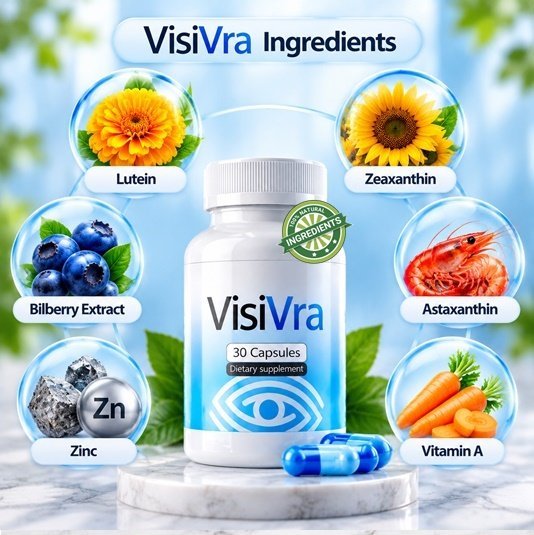
The 6-bottle bundle works out at $49 a bottle; every bundle carries a 60-day refund window that starts on your purchase date.
See Visivra OfferPaid linkQuick profile
| Profile | |
|---|---|
| Family | Xanthophyll carotenoid (yellow plant pigment) |
| Stored in | Macula of the retina; eye lens |
| Job | Absorbs blue light; antioxidant |
| Research doses | 6–20 mg/day; 10 mg in AREDS2 |
| Visivra dose | Not published |
| Top foods | Spinach, kale, collards, egg yolk |
| Grade | A — strong |
Where lutein comes from
Lutein is a yellow pigment made by plants, especially dark leafy greens. Humans can’t make it, so every molecule in your eye came from your diet or a supplement. Commercial lutein is usually extracted from marigold flowers. Together with zeaxanthin and meso-zeaxanthin, it makes up the yellow macular pigment — and, according to the Linus Pauling Institute, lutein and zeaxanthin are the only carotenoids found in the human lens.
What lutein does in the eye
Picture a yellow filter laid over the most important part of your retina. That’s the macular pigment. Depending on how dense it is, it can absorb up to 90% of incoming blue light before it reaches the cones. Lutein also quenches reactive oxygen molecules — useful in tissue that’s constantly exposed to light and oxygen. Denser macular pigment has been associated with better contrast sensitivity and faster recovery from glare.
The seller offers 2-, 3- and 6-bottle bundles. If you take prescription medicine, show the label to your pharmacist first.
See Visivra OfferPaid linkEvidence check
Macular pigment. Supplements raise macular pigment density over weeks to months.
Visual function. A meta-analysis of eight trials, summarised by the Linus Pauling Institute, found improved visual acuity and contrast sensitivity with lutein and/or zeaxanthin supplements (lutein 6–20 mg/day).
Age-related macular degeneration. In AREDS2, a formula including 10 mg lutein and 2 mg zeaxanthin reduced progression from intermediate to advanced AMD by about 25%, and lutein/zeaxanthin did better than beta-carotene for progression to late AMD.
Cataract. People who eat the most lutein-rich food have lower cataract rates in observational studies, but AREDS2 supplements showed no effect on cataracts.
Diet studies. In large US cohorts, the highest lutein + zeaxanthin intakes were linked with lower risk of advanced AMD; around 6 mg/day from food was associated with lower risk than under 2 mg/day.
Research dose vs Visivra
| Source | Lutein |
|---|---|
| AREDS2 formula | 10 mg/day |
| Meta-analysis range | 6–20 mg/day |
| One cup cooked frozen spinach | ≈ 29.8 mg (with zeaxanthin) |
| Visivra per serving | Not disclosed; part of the 351 mg proprietary blend |
If Visivra’s figure is around 10 mg, it matches the research. If it’s 1–2 mg, expect much less.
Getting lutein from food
Top sources: spinach, kale, collard and turnip greens, Swiss chard, broccoli, peas, corn and egg yolks. Light cooking and a little oil or fat improve absorption. A spinach omelette or a kale salad with olive oil delivers more lutein than most capsules.
Who should be careful
Lutein itself has an excellent safety record — AREDS2 participants took 10 mg daily for years. High total carotenoid intake can give skin a faint yellow tint (harmless). Anyone pregnant, breastfeeding or managing a health condition should still check any supplement with a doctor, and people using orlistat may absorb less.
How lutein fits into Visivra
Lutein is the backbone of Visivra’s formula and the main reason the product makes biological sense. Its value to you depends on two numbers: how much lutein is in the capsule, and how much you already get from food.
Lutein and screens
Because the macular pigment absorbs blue light, lutein is often marketed for screen users. It’s worth separating two things: the macular pigment is a long-term protective filter, while day-to-day screen fatigue is mostly about blinking and focusing effort. The American Academy of Ophthalmology says there’s no evidence blue light from devices damages the eye. Lutein supports the eye’s natural filter over months; screen breaks fix today’s tiredness.
Verdict
Grade A. The best-supported ingredient in Visivra. It helps maintain the macula’s natural light filter and, at AREDS2 doses, contributed to slowing intermediate AMD. It won’t prevent cataracts in supplement form and can easily be obtained from greens.*
Orders go through the seller’s BuyGoods checkout. Check the final total and screenshot it before you confirm.
See Visivra OfferPaid linkCommon questions
Is lutein good for your eyes?
Yes — it’s a major component of the macular pigment that filters blue light, and trials show supplements raise that pigment.
How much lutein per day?
There’s no official requirement. Research used 6–20 mg/day; AREDS2 used 10 mg.
Can you take too much lutein?
It’s well tolerated at studied doses. Very high carotenoid intake can tint skin slightly yellow.
Lutein from food or supplements?
Both work. A cup of cooked spinach provides more than most supplements.
How much lutein does Visivra contain?
The sales page doesn’t say; check the Supplement Facts.
Sources
- Linus Pauling Institute, Oregon State University — Carotenoids
- National Eye Institute — Age-Related Eye Disease Studies (AREDS/AREDS2): major findings
Each reference was opened and read when this page was last updated (October 18, 2026).
*The Food and Drug Administration has not evaluated these statements. Visivra is not intended to diagnose, treat, cure, or prevent any disease. We publish general information, not personal medical advice: please check with your doctor, pharmacist or eye-care professional before starting a supplement — particularly during pregnancy or breastfeeding, alongside medication, or with an existing eye condition.