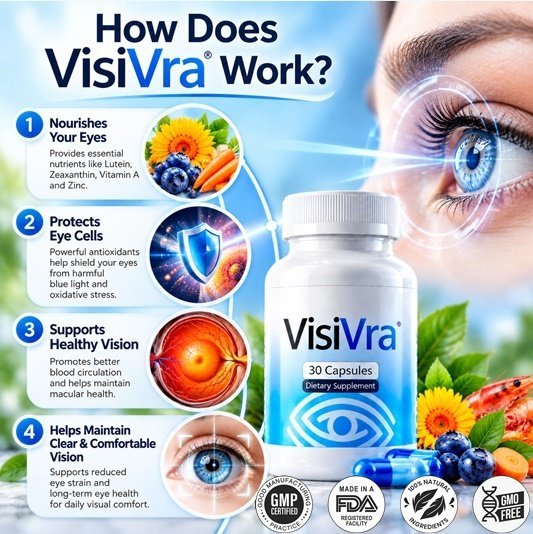
- Following a ray of light
- Why the retina needs protecting
- Step 1 — Lutein and zeaxanthin build a filter
- Step 2 — Astaxanthin and bilberry mop up oxidants
- Step 3 — Vitamin A and zinc keep the light sensors running
- The whole sequence at a glance
- What has to go right for this to work
- What the mechanism can’t do
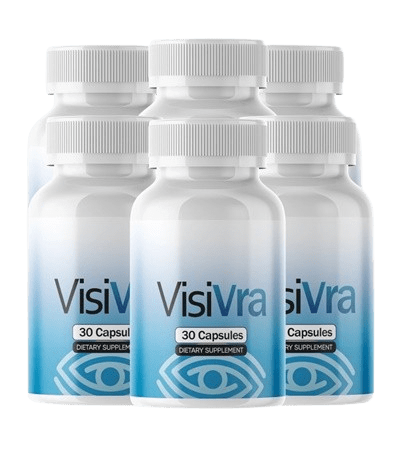
The 6-bottle bundle works out at $49 a bottle; every bundle carries a 60-day refund window that starts on your purchase date.
See Visivra OfferPaid linkFollowing a ray of light
Light passes through the clear cornea, the pupil and the lens, and lands on the retina — a sheet of nerve tissue lining the back of the eye. Two cell types turn light into signals:
- Rods, spread around the edge of the retina, handle low light and motion.
- Cones, packed into a small central zone called the macula, handle colour and detail.
Reading, recognising faces and seeing a phone screen all depend on the macula. It’s also where much of the nutrition research focuses.
Why the retina needs protecting
The retina has one of the highest oxygen demands of any tissue and is bathed in light all day. Oxygen plus light generates reactive molecules that can damage cell membranes — so-called oxidative stress. Over decades, this wear and tear is thought to contribute to age-related eye changes. The eye defends itself with pigments, antioxidant enzymes and vitamins. Visivra’s ingredients aim to top up those defences.
Step 1 — Lutein and zeaxanthin build a filter
Lutein and zeaxanthin travel in the blood and concentrate in the macula, forming the macular pigment. According to the Linus Pauling Institute, this pigment can absorb up to 90% of blue light, depending on how dense it is, which may limit light-driven damage. Supplementing these carotenoids raises pigment density gradually.
Strength of evidence: good. This is the best-documented mechanism in the formula.
The seller offers 2-, 3- and 6-bottle bundles. If you take prescription medicine, show the label to your pharmacist first.
See Visivra OfferPaid linkStep 2 — Astaxanthin and bilberry mop up oxidants
Astaxanthin is an unusually potent antioxidant in lab tests. Researchers have also suggested it may relax the ciliary muscle that adjusts focus during close work. A 2023 trial found a benefit in visual acuity after screen work for people 40+, but not under 40.
Bilberry anthocyanins are antioxidants too. In people, though, NCCIH reports the strongest studies found no night-vision gain.
Strength of evidence: limited.
Step 3 — Vitamin A and zinc keep the light sensors running
Inside rod cells, vitamin A joins a protein to form rhodopsin. Each photon that hits rhodopsin bleaches it, and it must be rebuilt — with vitamin A. That’s why night blindness is the first sign of deficiency, according to the NIH.
Zinc is plentiful in the retina and helps release vitamin A from the liver and convert it inside the eye. It’s also part of several antioxidant enzymes.
Strength of evidence: good for correcting a shortfall; extra doesn’t boost normal vision.
The whole sequence at a glance
| Stage | What happens | Visivra ingredient | Evidence |
|---|---|---|---|
| Filter | Blue light absorbed before reaching cones | Lutein, zeaxanthin | Good |
| Defend | Oxidants neutralised | Astaxanthin, bilberry | Limited |
| Sense | Rhodopsin rebuilt for dim light | Vitamin A | Good if low |
| Support | Vitamin A delivered and used | Zinc | Good if low |
What has to go right for this to work
For the mechanism to translate into a real benefit, three things matter:
- Dose. Studies used specific amounts (for example 10 mg lutein). Visivra doesn’t publish its amounts.
- Absorption. These are fat-soluble; take them with a meal containing some fat.
- Time. Macular pigment builds over weeks and months, not days.
And a fourth: your starting point. Someone who eats a cup of spinach most days already has plenty of lutein.
What the mechanism can’t do
None of these steps changes the length of your eyeball or the flexibility of your lens, so the need for glasses stays the same. They can’t drain fluid in glaucoma, clear a cataract or regrow damaged retinal cells. If something about your vision has changed, an eye exam is the first step.
Orders go through the seller’s BuyGoods checkout. Check the final total and screenshot it before you confirm.
See Visivra OfferPaid linkCommon questions
Where in the eye does Visivra act?
Mainly the retina — especially the macula, where lutein and zeaxanthin accumulate, and the rod cells, which use vitamin A.
Does Visivra block blue light like glasses?
No. Lutein and zeaxanthin build a natural filter inside the eye over time. It’s a different, gradual process.
Why take Visivra with food?
Its carotenoids and vitamin A dissolve in fat, so a meal with some fat improves absorption.
How long before the macular pigment changes?
Studies show increases over weeks to months of consistent intake.
Is the mechanism proven for Visivra itself?
The mechanisms are documented for the individual ingredients. Visivra as a product hasn’t been tested in a published study.
Sources
- Linus Pauling Institute, Oregon State University — Carotenoids
- Sekikawa T. et al. Effects of diet containing astaxanthin on visual function in healthy individuals: a randomized, double-blind, placebo-controlled, parallel study. J Clin Biochem Nutr. 2023;72(1):74–81
- NCCIH — Bilberry: Usefulness and Safety
- NIH Office of Dietary Supplements — Vitamin A and Carotenoids: Health Professional Fact Sheet
- NIH Office of Dietary Supplements — Zinc: Health Professional Fact Sheet
- National Eye Institute — Age-Related Eye Disease Studies (AREDS/AREDS2): major findings
Each reference was opened and read when this page was last updated (October 18, 2026).
*The Food and Drug Administration has not evaluated these statements. Visivra is not intended to diagnose, treat, cure, or prevent any disease. We publish general information, not personal medical advice: please check with your doctor, pharmacist or eye-care professional before starting a supplement — particularly during pregnancy or breastfeeding, alongside medication, or with an existing eye condition.